

Canon EF 800mm f/5.6L IS vs RF 800mm f/5.6L IS – A Real-World Wildlife Perspective
‘A real-world comparison from the Canadian wilderness’
Canon EF 800mm f/5.6L IS vs RF 800mm f/5.6L IS: A Real-World Field Comparison
Super-telephoto lenses occupy a very special place in photography and videography. The 800mm focal length, in particular, is a tool that allows you to capture wildlife at a safe distance, observe natural behavior, and isolate subjects in a way shorter focal lengths simply cannot. For me, capturing a bear, wolf, or bird of prey without disturbing them is invaluable. Having used the Canon EF 800mm f/5.6L IS for over six months, I recently had the opportunity to test the newer Canon RF 800mm f/5.6L IS in a rigorous field and video comparison, thanks to Canon Canada for loaning me the RF lens.
This review covers technical specifications, optical performance, field observations, video usability, and real-world wildlife testing, including a slightly unconventional but highly effective controlled subject: my son’s soft toy, Selwyn the Sloth. I’ve also covered a full in the field review on my YouTube Channel which is linked below.
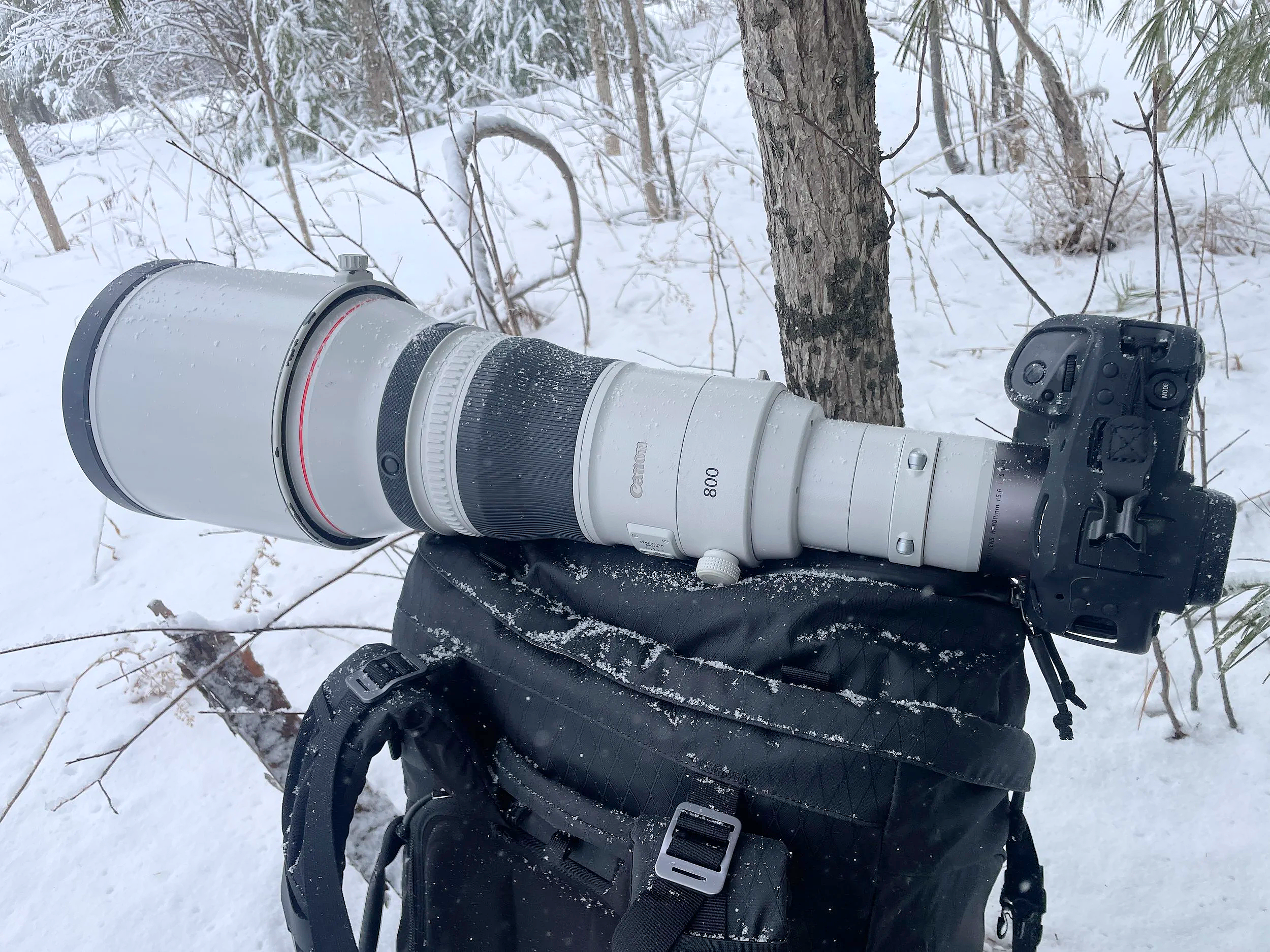
The RF 800mm F5.6 L IS comes fully weather sealed even in the harshest of environments.
Field Testing in Extreme Conditions
I tested both lenses in the Canadian wilderness on a bitterly cold day, with temperatures dropping to -25°C. The conditions included snow, frost, and very strong gusts of wind. In these conditions, lenses not only need to perform optically but also maintain operational reliability.
Observations:
Both lenses’ weather sealing was excellent. Snow and frost did not penetrate the lens barrels, and all electronic functions, autofocus, image stabilisation, and control rings performed flawlessly.
Both lenses remained stable when moving between extreme cold outdoors and slightly warmer interiors, with no condensation inside the lens.
The RF’s lighter weight (~3.1 kg vs ~4.5 kg for the EF) made handheld shooting far more comfortable over extended sessions, which was especially helpful when tracking moving wildlife for video sequences.
Weather sealing combined with robust build quality ensures that both lenses are field-ready, even in extreme winter conditions, making them reliable tools for professional wildlife photography and videography.
Weight and Handling
The difference in weight between the two lenses is immediately noticeable:
EF 800mm f/5.6L IS: - 4.5 kg (9.9 lbs)
RF 800mm f/5.6L IS: - 3.1 kg (6.9 lbs)
The RF is 3 pounds lighter, which may not sound dramatic until you’ve been holding it for hours. The reduced weight made handheld shooting much more feasible, whether following deer through dense trees or shooting birds in flight. Ergonomics and handling matter in extreme conditions, and the RF clearly benefits here.
Weight and Handling
The difference in weight between the two lenses is immediately noticeable:
EF 800mm f/5.6L IS: - 4.5 kg (9.9 lbs)
RF 800mm f/5.6L IS: - 3.1 kg (6.9 lbs)
The RF is 3 pounds lighter, which may not sound dramatic until you’ve been holding it for hours. The reduced weight made handheld shooting much more feasible, whether following deer through dense trees or shooting birds in flight. Ergonomics and handling matter in extreme conditions, and the RF clearly benefits here.
Autofocus and Tracking Performance
Autofocus is critical at 800mm, especially for fast-moving or partially obscured subjects.
The RF 800mm impressed with its responsiveness. Birds at distance were tracked effortlessly, and even when partially masked by branches, the lens reacquired focus quickly, almost like a missile locking onto its target.
The EF 800mm is by no means slow; it performed admirably and did not feel inferior in most situations. Any differences were subtle and often only noticeable in very challenging tracking scenarios.
The integration of the RF lens with Canon mirrorless bodies enhances autofocus performance, particularly in continuous AF and video modes, providing smooth, predictable results.
Minimum Focus Distance and Composition Flexibility
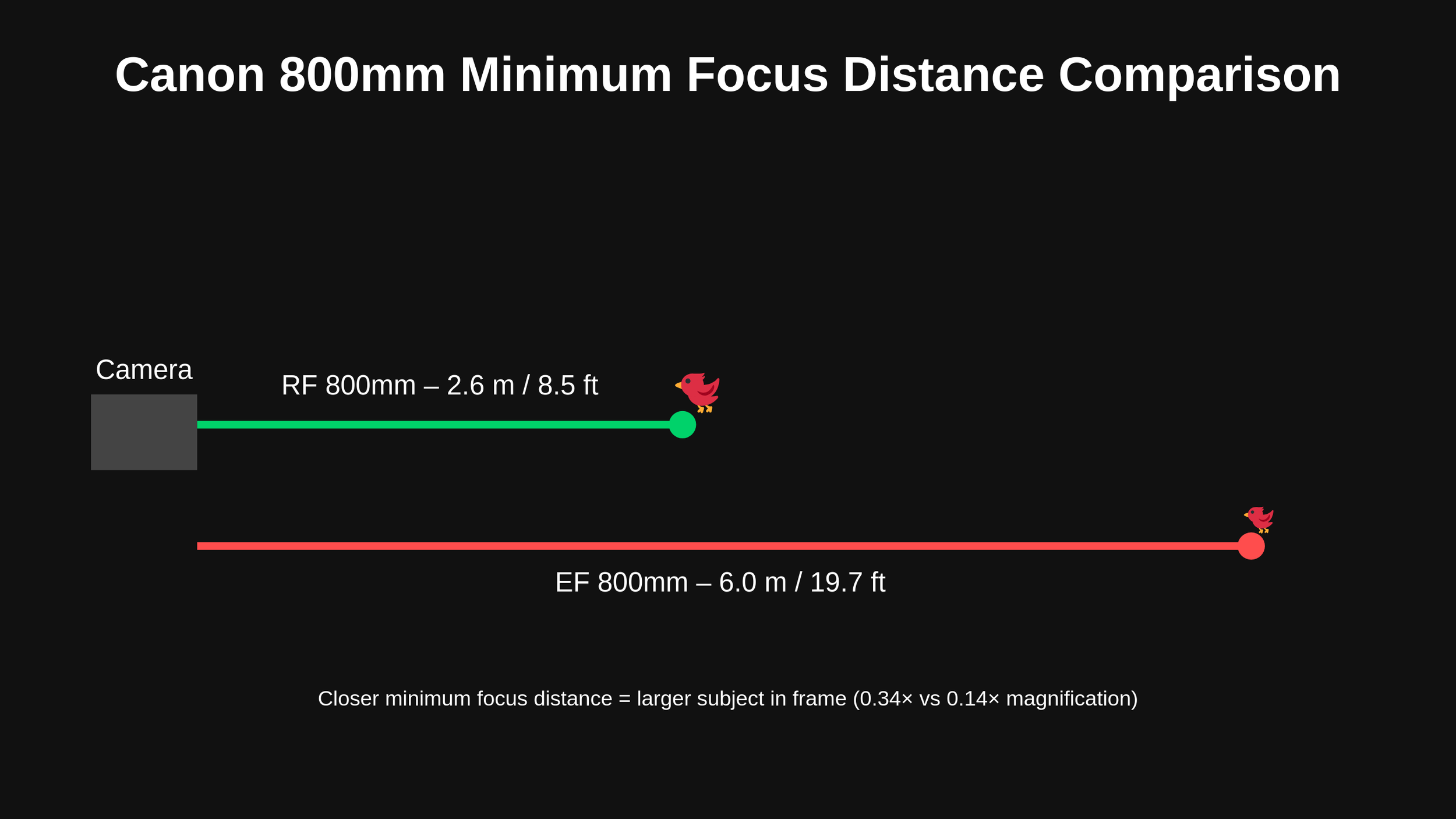
A key improvement on the RF lens is the minimum focus distance (MFD):
EF 800mm: 6 meters
RF 800mm: 2.6 meters
This reduction is significant. It allows for tighter framing, closer observation of subjects, and more creative compositions. In wildlife video, this flexibility is invaluable when a subject approaches closer than expected or when capturing intimate behavioral details.
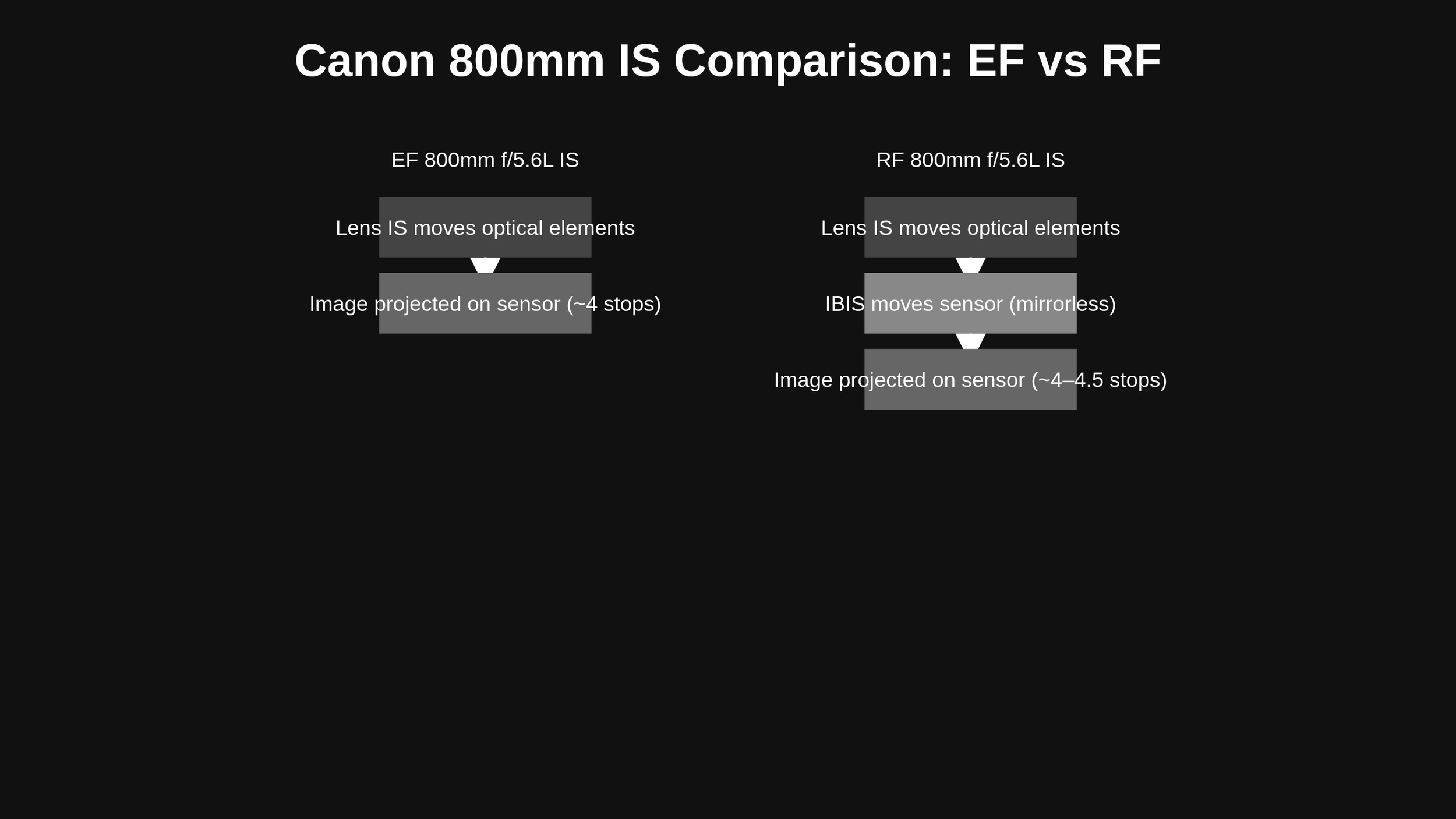
Image Stabilization and Video Use
The RF 800mm features 4.5 stops of IS, slightly better than the EF’s ~4 stops. More importantly, the RF introduces three IS modes:
Standard for handheld stills
Panning for horizontal tracking
Video-optimized stabilisation
In practical testing:
Handheld video of birds and deer was smoother with the RF, showing less visible shake compared to the EF.
Power focus allows smooth, controlled focus pulls during video, something impossible with the EF without additional equipment.
The manual focus sensitivity adjustment (three modes) provides precise control for cinematic sequences or rapid wildlife action.
In my tests, shooting handheld video in extreme winter conditions, the RF’s IS and lighter weight were a combination that made prolonged shooting much easier and produced consistently usable footage.
Optical Performance and Coatings
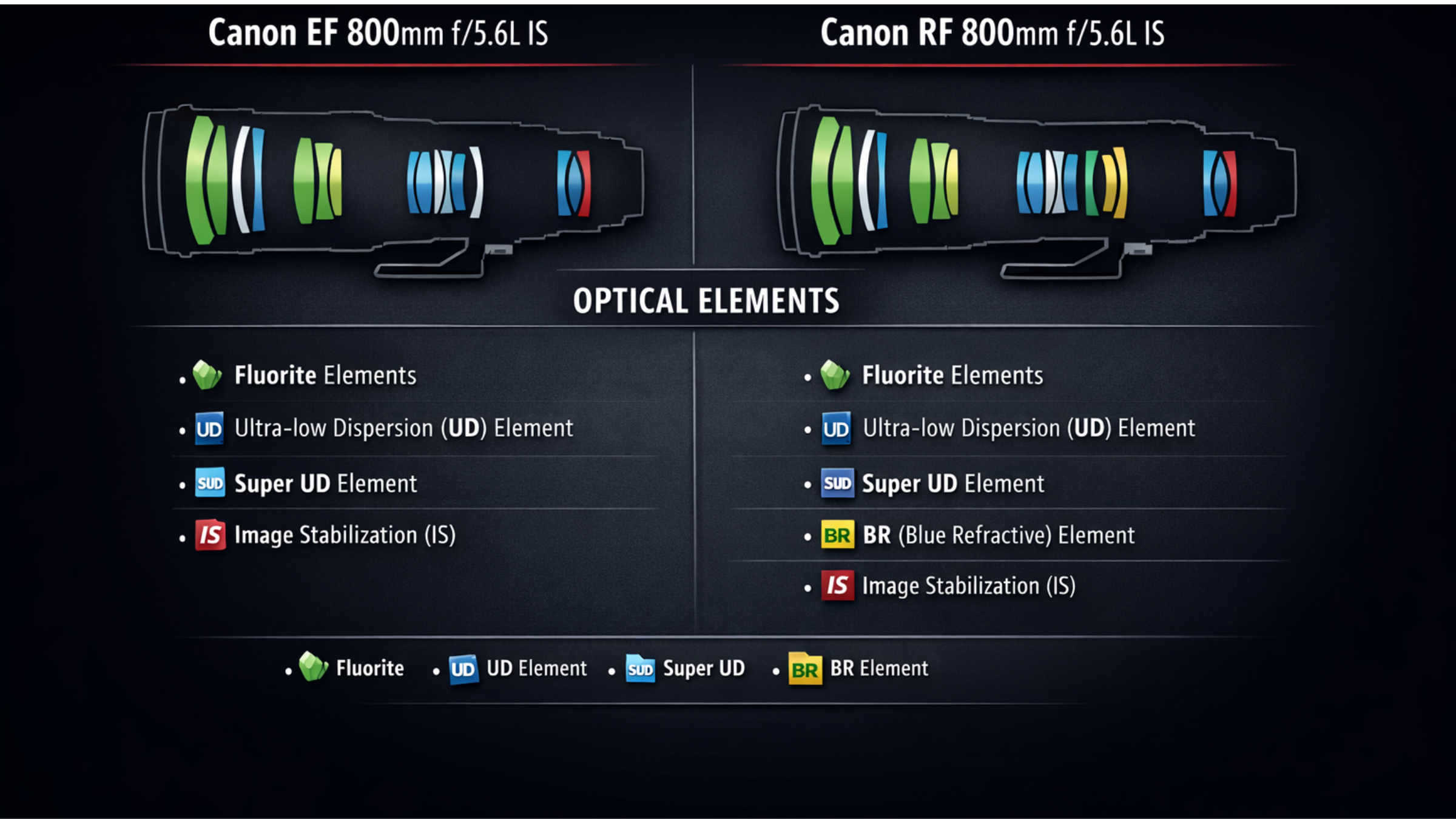
Both lenses feature Super ED glass to minimize chromatic aberration, along with high-quality lens coatings for flare and ghosting control.
The RF lens adds ASC (Air Sphere Coating), which reduces ghosting and flare more effectively than the EF lens. During my field testing:
Backlit snow scenes produced cleaner results with the RF lens.
Micro-contrast was slightly improved, providing crisper details on feathers, fur, and other fine textures.
Some reviewers have suggested the RF 800mm can be soft in the center or at edges, but in my limited testing, I did not notice this issue.
Overall, both lenses produce professional-level optical performance, but the RF’s coatings and design improvements give it a slight edge in challenging light.
Drop-In Filters and Lens Foot
Both the Canon EF and RF 800mm f/5.6L IS lenses are compatible with drop-in filters, which is extremely convenient for using polarizers or ND filters on such large super-telephoto lenses. I haven’t tested both versions with drop-in filters, but I am confident they would performed flawlessly, with no noticeable vignetting or color shifts, a real advantage when shooting wildlife in variable light conditions.
When it comes to the lens foot, I’ve found that aftermarket options often suit me better than Canon’s standard white foot. While the stock foot is solid and well-engineered, some of the aftermarket versions offer a more compact design, smoother rotation, a straight Arca‑Swiss fit, and even a slight weight saving. This makes them much more convenient when hand-holding or mounting on a tripod or monopod. On long shoots in the field, that little extra comfort, flexibility, and lighter feel can make a noticeable difference, especially when tracking wildlife for extended periods.
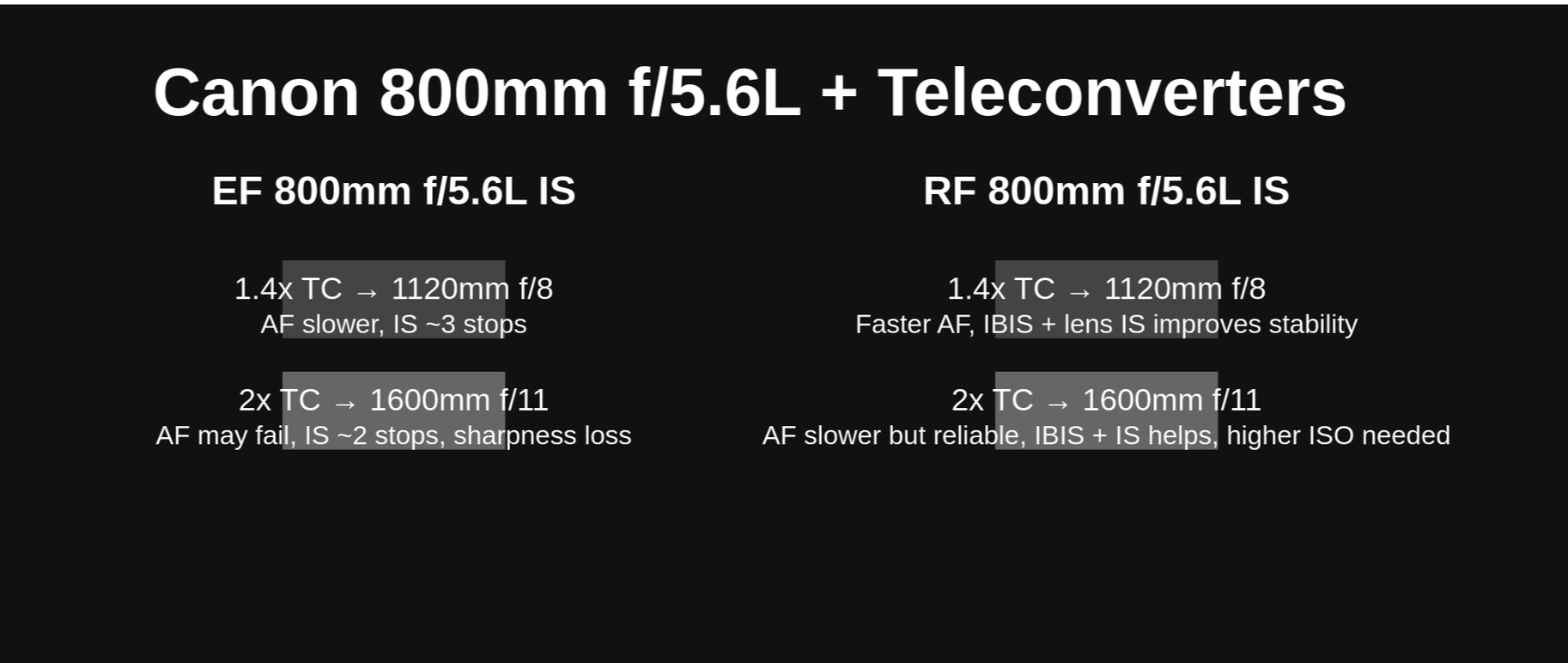
Teleconverter Compatibility
Both the EF and RF 800mm lenses are fully compatible with Canon’s teleconverters, giving you even more reach when needed. The EF 800mm works with the EF 1.4x and 2x Extender MK III, while the RF 800mm pairs with the newer RF 1.4x and RF 2x extenders. That said, I didn’t test either lens with teleconverters during this field comparison.
Personally, I’m not one for using teleconverters unless absolutely necessary. I much prefer the native reach and optical performance of an 800mm lens, as adding a teleconverter can introduce a slight loss in image quality, reduce light transmission, and potentially impact autofocus performance. For me, the whole point of using an 800mm is to get the best possible results straight out of the lens without needing to extend it further. That said they provide extended reach if required.
Controlled Testing with Selwyn the Sloth
To evaluate lens performance under similar conditions, I used my son’s soft toy, Selwyn the Sloth, as a test subject. This allowed me to shoot the same object in the same position, under near identical lighting, not withstanding variables like subject movement or changing environmental conditions due to shooting outdoors but it was as close as I could do in a real world shooting situation.
What I tested:
Sharpness and micro-detail
Contrast and color fidelity
Ghosting and flare
Chromatic aberration
Edge-to-edge performance
Observations:
The RF lens rendered Selwyn’s eyes with slightly more crispness, while the EF appeared a touch softer in the same region.
Overall sharpness, contrast, and color were excellent on both lenses, but the RF’s coatings and optical improvements provided a subtle advantage in fine detail.
Using Selwyn as a subject, combined with wildlife testing over 10 days (birds, deer, and more), allowed me to balance real-world results with semi-controlled situations.
The RF 800mm performed sharply at f/5.6 through to f/9, and was extremely sharp at f/8, which I know to be its sweet spot. The YouTube video explains this in more detail, showing side-by-side comparisons and how even small changes in aperture affect image crispness. Interestingly, the EF 800mm produced excellent results as well, though the eyes on Selwyn were slightly softer compared to the RF at the same apertures.

Canon R3 - RF 800mm F5.6 L IS - 1/1000th Sec - F5.6 - ISO 400 - Un-edited RAW File

Canon R3 - EF 800mm F5.6 L IS - 1/1000th Sec - F5.6 - ISO 400 - Un-edited RAW - Slight lighting change shows darker image
Real-World Wildlife Testing
Over the last 10 days, both lenses were used extensively in real-world scenarios:
Birds in flight and perched in trees
Deer moving through mixed forest
Key insights:
Both lenses captured sharp, high-quality stills, with the RF showing a very slight edge in clarity under ideal conditions.
Tracking with the RF during video sequences was smoother and more predictable, though the EF remained highly competent.
The longer focal length allowed for capturing undisturbed natural behavior, which is invaluable in wildlife photography and cinematography.
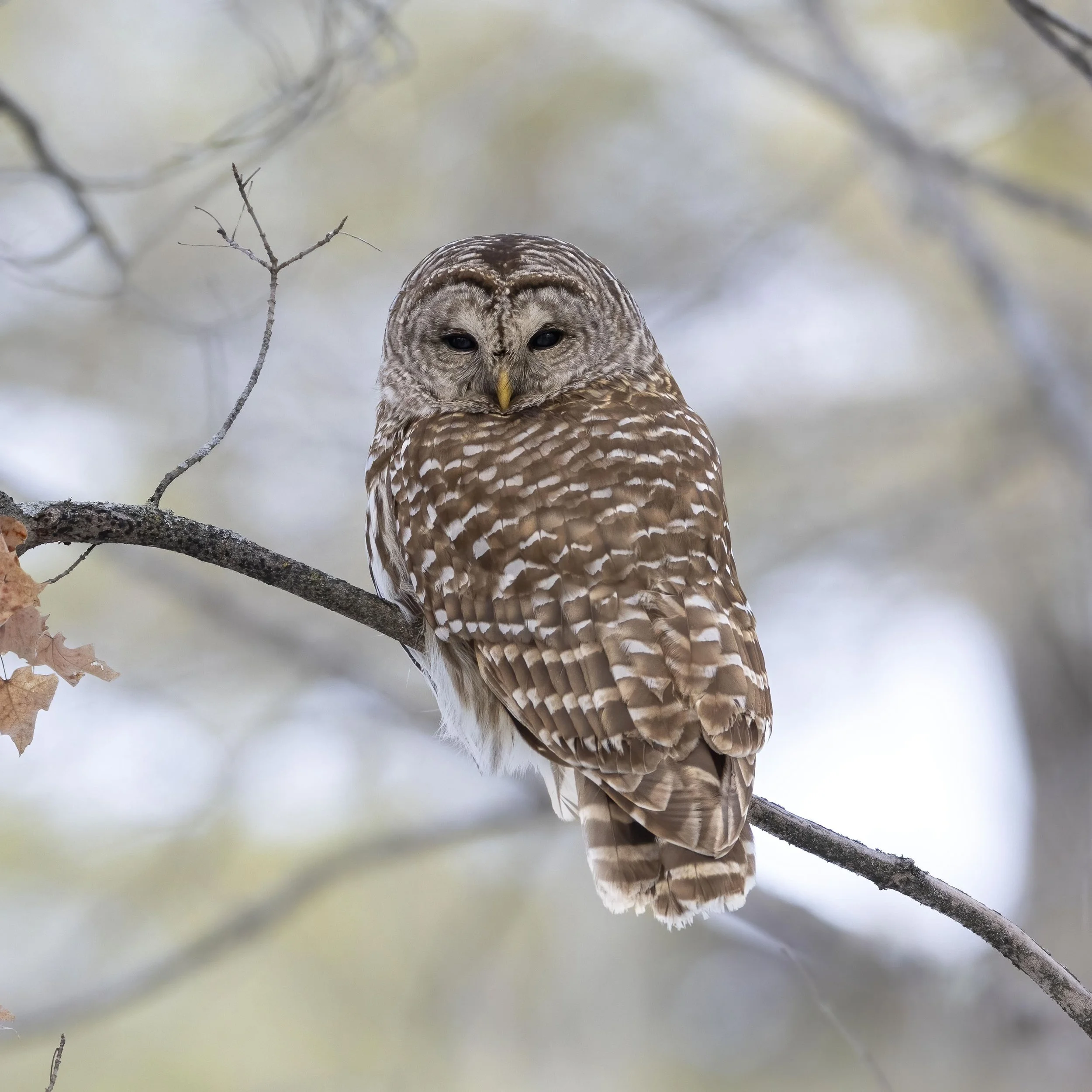
Barred Owl - Canon R3 - RF 800mm F5.6 L IS - 1/320th Sec - f8 - ISO 250 - Handheld
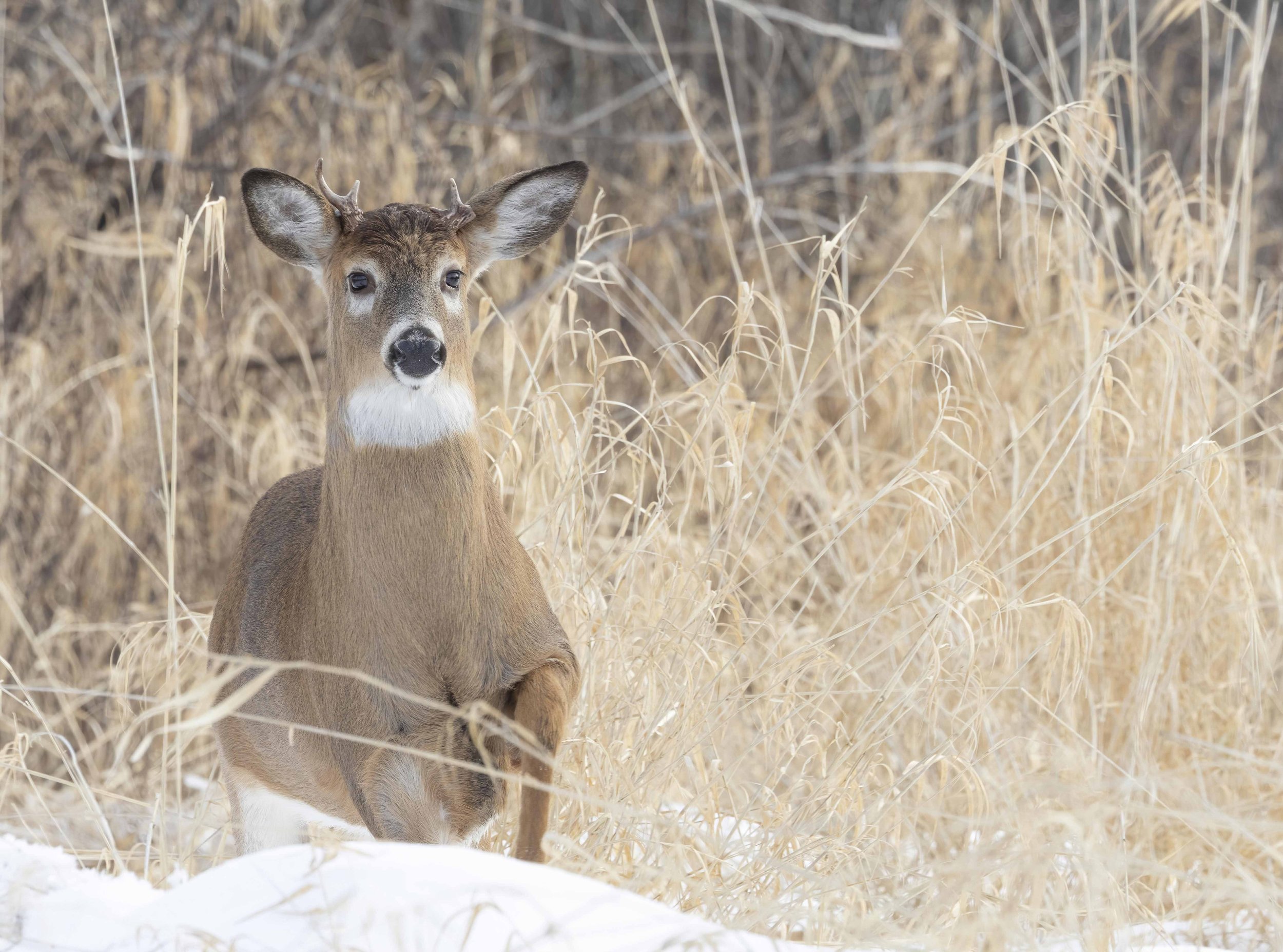
White Tailed Deer - Canon R3 - RF 800mm F5.6 L IS - 1/500th Sec - f7.1 - ISO 400 - Handheld
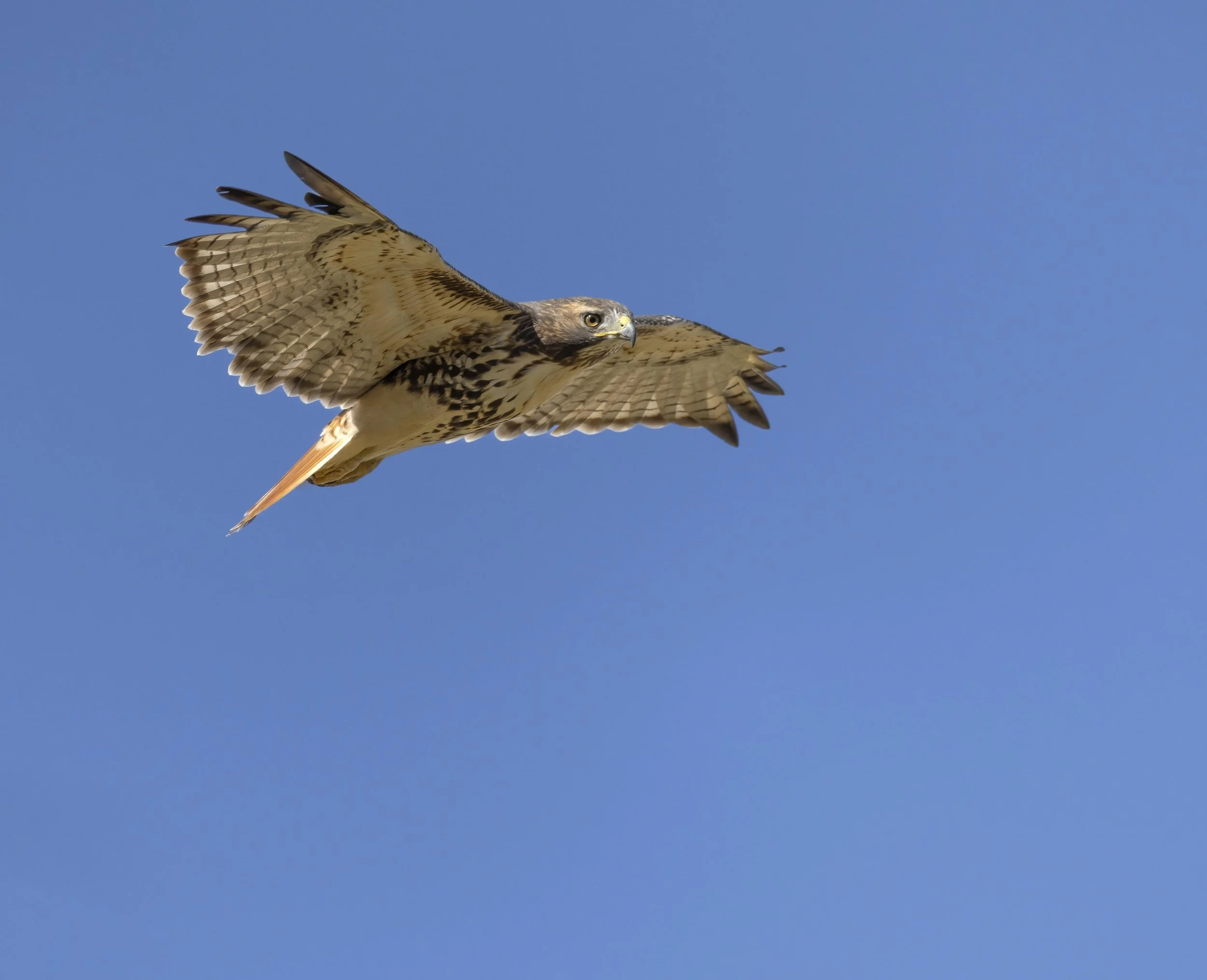
Red Tailed Hawk - Canon R3 - RF 800mm F5.6 L IS - 1/3200th Sec - f5.6 - ISO 640 - Tripod Mounted
Price and Market Considerations
The cost difference is significant:
RF 800mm f/5.6L IS: ~£19,000 ( Used Market Limited )
EF 800mm f/5.6L IS (used): £3,000–£4,500
The RF lens represents a major investment and is one of Canon’s most expensive mirrorless lenses. For those who cannot justify the price, the EF remains a highly capable and more accessible option.
Alternatives: RF 400mm + Teleconverters
While the RF 400mm f/2.8 with teleconverters can approach 800mm, it comes at a cost:
Slightly reduced image quality compared to a native 800mm lens
Potential impact on autofocus performance
Reduced effective light transmission
For those looking at other options beyond the RF 800mm f/5.6L IS, the Canon RF 600mm f/4 L IS USM is an interesting alternative. Without any teleconverters, the two lenses actually weigh about the same, though the RF 600 is a little longer and slightly wider. Once you add the 1.4x extender to the RF 600, the balance shifts a bit, the RF 800 ends up being around 200 g (7 oz) lighter, while the RF 600’s overall length increases by roughly 0.8 inches (20.5 mm).
When it comes to reach, the RF 800 still has the advantage: its maximum magnification is 0.34x, while the RF 600 with a 1.4x extender reaches 0.24x. With a 2x extender, the RF 800 can go up to 1600mm compared to 1200mm on the RF 600 setup. That said, the RF 600 paired with a 1.4x is considerably less expensive than the RF 800 and is more than adequate for most wildlife photographers. For many, it provides a practical compromise between weight, cost, and reach, while still delivering excellent image quality. For optimal sharpness and overall image quality, a dedicated 800mm lens remains the best choice for me.
Advantages of 800mm Focal Length
The 800mm focal length allows photographers and videographers to:
Capture sensitive wildlife from a safe distance
Document natural behavior without disturbance
Isolate subjects in a way shorter lenses cannot
For me, this ability to stay invisible while photographing bears, wolves, moose, or birds of prey is priceless.
Side-by-Side Specifications
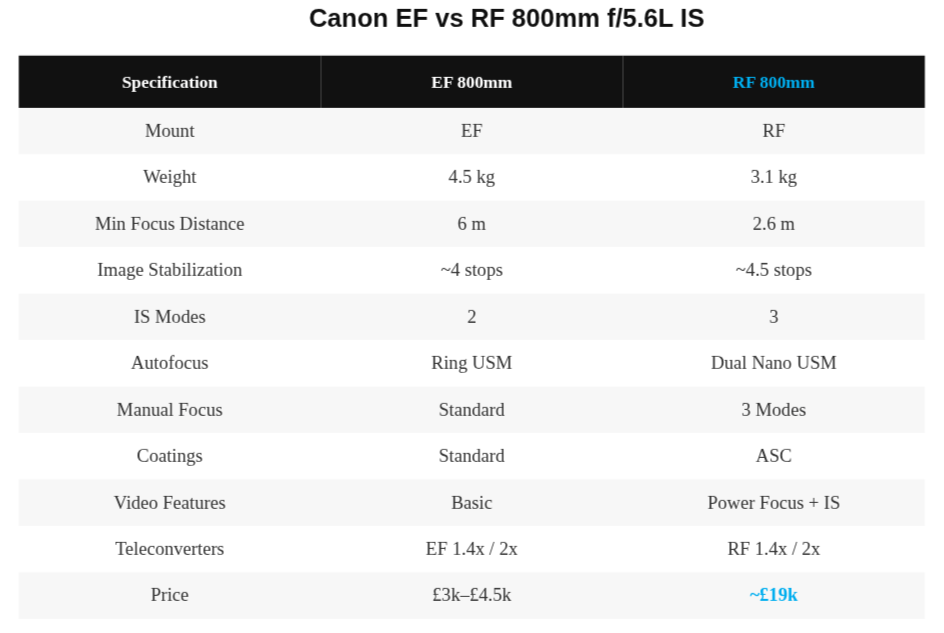
This table provides a clear, side-by-side comparison of the key specifications and features of the Canon EF 800mm f/5.6L IS and the newer RF 800mm f/5.6L IS lens.
It highlights the main differences in areas such as weight, minimum focus distance, image stabilisation, autofocus technology, and overall functionality, giving a quick and easy reference to understand how the newer RF version improves upon the older EF model in both performance and usability.
Final Thoughts
The RF 800mm f/5.6L IS is a remarkable lens, particularly for video. It’s lighter, easier to handle, and offers improvements in stabilisation, close focusing, autofocus responsiveness, and optical coatings. Subtle improvements in sharpness, contrast, and flare handling give it an edge over the EF in controlled tests like with Selwyn, and in video tracking scenarios.
The EF 800mm f/5.6L IS remains an outstanding lens for stills and video, particularly given its current used market value. While the RF may be slightly better technically, the EF is far from obsolete, and at this stage, I don’t feel the need to upgrade. Over time, as handling fatigue becomes more relevant or RF lenses enter the used market, an upgrade may become more appealing.
Ultimately, both lenses are capable of capturing world-class wildlife photography and video, and the choice comes down to budget, workflow, and the importance of the RF’s incremental improvements.
A special thanks again to Canon Canada for providing the RF 800mm for testing. It made this detailed side-by-side comparison possible.
Thanks for taking the time to read my blog! If you’d like to share your thoughts, please leave a comment in the section below — it’s always appreciated. Thanks again, and I’ll see you in the next blog!